Why Does the Moon Change Shape?
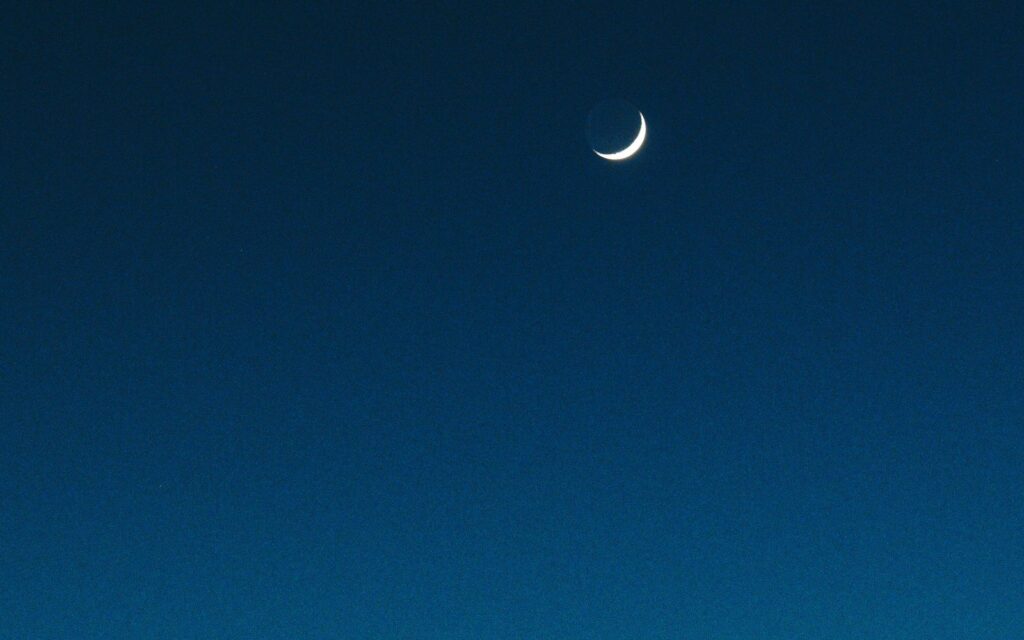
Short answer: The Moon does not change shape at all. The Sun always lights one half of it, and as the Moon travels around Earth over about 29.5 days, we see more or less of that lit half from our viewpoint. A “crescent” is just a thin slice of the sunlit side, seen at an angle.
Key takeaways
- The Moon makes no light of its own. It reflects sunlight, and half of it is always lit.
- Phases come from our changing viewing angle, not from Earth’s shadow. Earth’s shadow causes lunar eclipses, which are rarer.
- There are eight named phases, and the cycle from one new Moon to the next takes about 29.5 days.
- The same face always points toward Earth because the Moon spins once per orbit.
- Which side is lit is flipped between the Northern and Southern Hemispheres, but the order of the phases is the same.
Half the Moon is always lit
Picture a ball held in front of a lamp. Whichever half of the ball faces the lamp is bright, and the other half is in shade, no matter where you stand. The Moon works the same way, with the Sun as the lamp. At any moment the half of the Moon facing the Sun is lit and the other half is dark.
What changes is where you are standing relative to that lit half. As the Moon circles Earth, we look at it from a gradually shifting angle. Sometimes we face the dark half, sometimes the lit half, and most of the time a mixture of the two. NASA puts it simply: the shape of the Moon is not changing through the month, only how much of its illuminated half we can see.
The eight phases in order
Astronomers split the cycle into eight named stages:
- New Moon: the lit half faces away from us, so the Moon is essentially invisible.
- Waxing crescent: a thin sliver appears and grows each day.
- First quarter: half of the face we see is lit. It is called a quarter because the Moon is a quarter of the way around its cycle, not because a quarter is lit.
- Waxing gibbous: more than half is lit and growing. “Gibbous” just means bulging.
- Full Moon: the whole face we see is lit.
- Waning gibbous: still more than half lit, but shrinking.
- Third quarter (also called last quarter): half lit again, on the opposite side from first quarter.
- Waning crescent: a shrinking sliver that leads back to the new Moon.
“Waxing” means growing and “waning” means shrinking. After the waning crescent, the cycle simply starts again.
Why the cycle takes 29.5 days
The Moon takes about 27.3 days to complete one orbit of Earth. But the cycle of phases, from one new Moon to the next, takes about 29.5 days. NASA attributes the difference to how sunlight falls on the Moon during its trip. In plain terms, Earth is also moving around the Sun during that month, so the Moon has to travel a little further than one full lap to line up with the Sun again. That is why a month on the calendar roughly matches the cycle, although it is not exactly the same length.
What you see and when it rises
Because the Moon moves around us, it rises and sets at different times each day. NASA describes these rough patterns for most latitudes and recommends a local prediction for exact times. This is a guide for what to expect, not a timetable.
| Phase | What you see | Roughly when it rises |
|---|---|---|
| New Moon | Not visible; dark side faces us | Rises and sets with the Sun |
| Waxing crescent | Thin growing sliver | Morning, after sunrise |
| First quarter | Half lit | Around midday |
| Waxing gibbous | More than half lit | Afternoon |
| Full Moon | Fully lit disc | Around sunset |
| Waning gibbous | More than half lit, shrinking | After sunset |
| Third quarter | Half lit, other side | Around the middle of the night |
| Waning crescent | Thin shrinking sliver | Before sunrise |
One surprise from the table: a waxing Moon is often up in the daytime. First quarter, for example, rises around midday, so you can see it in the afternoon sky. The Moon is not just a night-time object.
Waxing or waning? A hemisphere guide
Here is the trick that most people never learn. Which side of the Moon looks lit depends on whether you live north or south of the equator, because you are looking at it from opposite “sides up”.
- Northern Hemisphere: a waxing crescent is a thin curve lit on the right. A waning crescent is lit on the left. NASA’s educational pages describe it this way.
- Southern Hemisphere: it is reversed. The Royal Astronomical Society of New Zealand gives the rule that the left side is lit before full Moon, and the right side after.
A handy way to use it: in the north, a Moon lit on the right is growing, so you are seeing the first half of the cycle. In the south, a Moon lit on the left is growing. Another clue that works anywhere is timing. If the Moon is up in the evening sky, it is probably waxing. If it is hanging in the morning sky, it is probably waning. That follows from the rise times in the table above.
Why we always see the same face
The Moon rotates on its own axis at exactly the same rate that it orbits Earth. One turn takes as long as one lap, so the same side always points toward us. That does not mean the far side is permanently dark. It gets just as much sunlight as the near side. NASA notes that “dark side” is really a misnomer, and that “far side” is the better name.
We actually see slightly more than half of the Moon over time. A slow rocking motion called libration tilts the Moon a little, so we sometimes glimpse bits beyond the edge of the usual face. It is a small effect, but it is why the total visible area is a bit more than 50 percent.
A common misconception: Earth’s shadow causes the phases
A very popular idea says that the phases happen when Earth’s shadow covers part of the Moon. It is understandable, but it is not true. The dark part of a crescent is not a shadow cast by Earth. It is the Moon’s own night side, the half the Sun is not lighting, which we are viewing from an angle. Earth’s shadow only ever reaches the Moon when the three bodies line up, and that is rare.
Earth’s shadow does matter, but for something else. A lunar eclipse happens when Earth sits exactly between the Sun and the Moon, so Earth’s shadow falls on the Moon. That can only happen at a full Moon. It does not happen every month because the Moon’s orbit is tilted by about 5 degrees compared with Earth’s orbit around the Sun, so the Moon usually passes above or below the shadow. NASA says that, counting lunar and solar eclipses together, the Sun, Earth and Moon line up anywhere from four to seven times a year.
| Feature | Moon phases | Lunar eclipse |
|---|---|---|
| Cause | Our viewing angle on the lit half | Earth’s shadow falls on the Moon |
| How often | Every cycle, about 29.5 days | Only when the alignment is exact |
| Which phase | All eight | Full Moon only |
Things to try
- Lamp and ball model. In a dim room, hold a ball at arm’s length near a single lamp, then slowly turn on the spot. Watch the lit part of the ball go from a thin crescent to full and back.
- Find a daytime Moon. Look for a waxing Moon in the afternoon sky. NASA suggests this as an easy first observation.
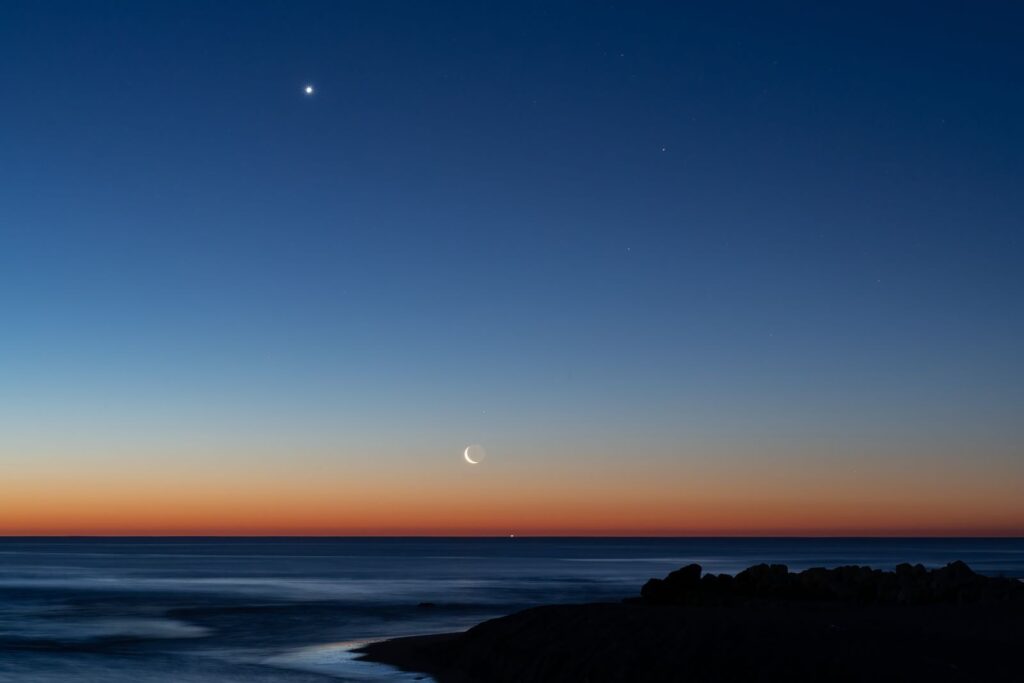
- Look for earthshine. On a thin crescent, you may see a faint glow on the dark part. NASA explains that this is sunlight reflected from Earth onto the Moon.
- Keep a Moon journal. Sketch the Moon at the same time each evening for a month. NASA recommends this activity.
- Test the hemisphere rule. Note which side is lit and whether the Moon rises before or after dark. Check whether your result matches the table.
Frequently asked questions
Does the Moon really change shape?
No. It stays the same sphere all month. Only our view of the sunlit half changes.
Why is the full Moon up all night?
At full Moon, the Moon is on the opposite side of Earth from the Sun. It rises around sunset and sets around sunrise, so it crosses the sky while the Sun is below the horizon.
Is there a dark side of the Moon?
Not in the sense people mean. The far side faces away from Earth but receives as much sunlight as the near side. It is hidden from us, not permanently dark.
Why does the new Moon not cause a solar eclipse each month?
The Moon’s orbit is tilted about 5 degrees relative to Earth’s orbit around the Sun, so at new Moon it usually passes above or below the Sun in our sky. An eclipse needs a precise alignment.
Closing thought
The Moon’s monthly dance is a lesson in perspective. The same ball, lit the same way, can look like a sliver, a half disc or a full circle just by changing where we stand. Once you know the trick, you can read the sky: lit side, rise time and direction all tell you where the Moon is in its cycle.
Sources
- Moon Phases – NASA Science, NASA
- What Are the Moon’s Phases?, NASA Space Place
- All About the Moon, NASA Space Place
- Eclipses and the Moon – NASA Science, NASA
- Royal Astronomical Society of New Zealand – Lunar Phases, Royal Astronomical Society of New Zealand
Last updated: November 2026. This article is general information, not scientific advice.