Why Are Plants Green?
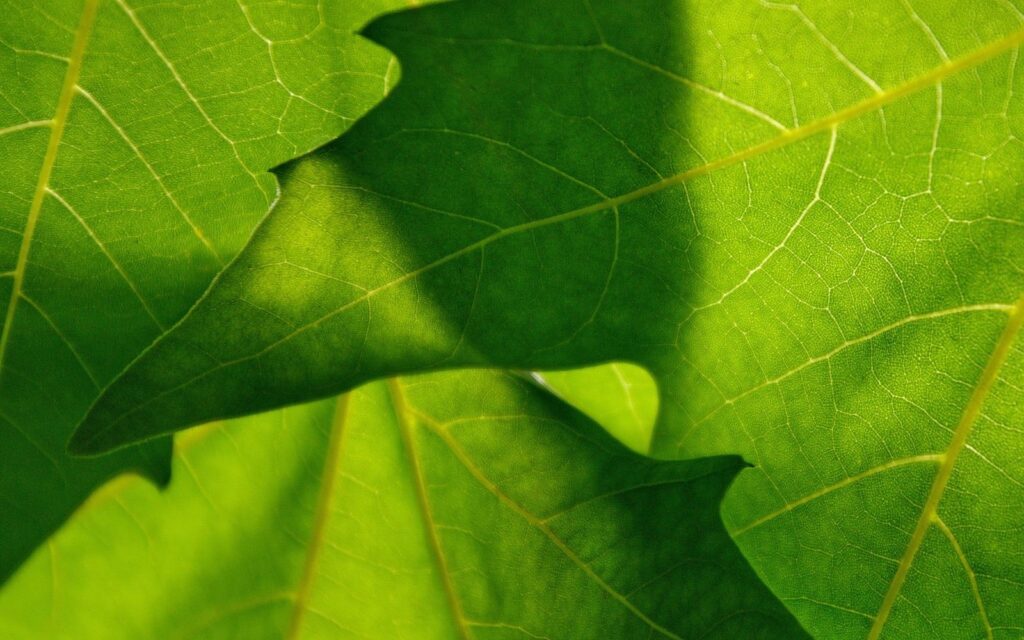
Short answer: Plants are green because chlorophyll, the pigment that captures light for photosynthesis, absorbs red and blue light strongly and green light less strongly. The green that is not absorbed is scattered back out of the leaf and into your eyes. Why plants did not evolve to absorb green too, and look black, is still a topic scientists discuss, and there are a few leading ideas.
Key takeaways
- Chlorophyll absorbs mostly red and blue wavelengths and is weaker at absorbing green, so leaves send green light back to us.
- Leaves do not reflect all the green. An ordinary leaf absorbs a good share of it, and green light that gets in can reach chloroplasts deep inside the leaf.
- Why plants are not black is still debated. Leading ideas involve steady energy supply in flickering light, spreading light evenly through the leaf, and the limits of the chemistry that follows.
- Other pigments, such as carotenoids and anthocyanins, are present or produced at different times and show through in autumn.
Light, colour and what we see
Sunlight is a mix of wavelengths, and our eyes read different wavelengths as different colours. When light hits a leaf, three things can happen to each wavelength: it can be absorbed, reflected or scattered back out, or passed through. The colour you see is whatever returns to your eyes.
A leaf looks green, then, because the wavelengths it takes in most readily are not the green ones. NASA education pages put it plainly: plants absorb most of the red and blue light they receive, absorb some green, and send the rest back, and that is why they look green.
What chlorophyll does
Chlorophyll is the pigment that gives leaves their colour and drives photosynthesis, the process that turns sunlight into sugars. It sits inside tiny compartments in leaf cells called chloroplasts. A pigment is simply a molecule that absorbs some wavelengths of light and not others. Chlorophyll absorbs blue and red light well. When a chlorophyll molecule absorbs a particle of light, that energy is passed along a chain of other molecules and eventually used to build sugars.
Plants keep making chlorophyll and breaking it down all through the growing season, so there is always a lot of it. That abundance is also why the green hides the other pigments in the leaf until autumn.
What happens to the green light?
It is tempting to think a leaf bounces all the green away like a mirror. It does not. Plant scientist Ichiro Terashima, writing for the University of Tokyo, explains that an ordinary leaf absorbs about 90 percent of red and blue light but only about 70 to 80 percent of green. Red and blue are mostly absorbed in the upper layers of the leaf. Green is absorbed less readily, so it travels deeper into the leaf, bounces around inside the spongy tissue, and some of it escapes back out. That escaping light is what we see.
The green that stays in the leaf is not wasted. A 2009 study in Plant and Cell Physiology, led by Terashima, found that in strong white light, green light drove photosynthesis in sunflower leaves more effectively than red light did. The explanation is the way light fades with depth. In bright light, chloroplasts near the surface can be saturated, while those deeper down get little. Green light penetrates further, so it can help the deeper chloroplasts. The authors suggest that leaves are green because of a balance between absorbing enough light overall and delivering light efficiently to every chloroplast.
Leaves also reflect another kind of light that we cannot see. NASA notes that leaf cell structure strongly reflects near-infrared light, and that a plant with more chlorophyll reflects more of it than an unhealthy plant. Comparing how a plant absorbs and reflects visible and infrared light is one way scientists assess its health.
Why aren’t plants black?
A black plant would absorb every colour, and that sounds ideal for catching energy. Why this did not happen is still debated, and no single answer has settled it. Here are the leading ideas, with how much support each has.
Idea 1: a steady supply beats a high peak
In 2020, a team including Nathaniel Gabor (University of California, Riverside) and Richard Cogdell (University of Glasgow) published a model in Science. It argues that the light-harvesting machinery in plants evolved for smooth, reliable output rather than maximum efficiency. Sunlight flickers as clouds pass and leaves shift in the wind, and a system tuned to the brightest part of the spectrum, the green, would see its energy supply swing too wildly. Tuning to the steeper red and blue edges of the spectrum cancels out more of that noise. The model’s predictions matched the absorption peaks of chlorophyll a and b, and also those of two kinds of bacteria. This is a published model with a match to data, but it is one proposal, and one of the researchers involved said he was not fully convinced at first that it would generalise to other organisms.
Idea 2: spread the light around
The Terashima explanation above says that weaker absorption of green lets light reach chloroplasts all through the leaf. This is supported by measurements in sunflower leaves.
Idea 3: the chemistry downstream is the limit
Terashima also points out that absorbing more light would not help much if the next step cannot keep up. He describes Rubisco, the enzyme that captures carbon dioxide, as slow and in need of large quantities, taking up roughly 30 to 50 percent of leaf protein. Chloroplasts therefore have to be spread thinly through the leaf, with light reaching all of them evenly, and green light helps with that.
These ideas are not necessarily rivals. They may each describe a piece of why leaves look the way they do.
A common misconception
People are often taught that plants are green because they “reject” or “don’t use” green light. The sources show it is more nuanced. A leaf absorbs a large share of green light, and the green that does penetrate helps power photosynthesis deep inside the leaf. Green is the least-absorbed colour, not an unused one. The wording matters because it shows why the question of black plants is genuinely open rather than a classroom puzzle with a one-line answer.
Other pigments in leaves
Chlorophyll is not the only pigment. Penn State Extension describes three main groups that matter for autumn colour.
| Pigment | Colour | When it is there | What it does |
|---|---|---|---|
| Chlorophyll | Green | Made and broken down all season | Captures light for photosynthesis |
| Carotenoids | Yellow, orange, some browns | Present all season, hidden by chlorophyll | Help protect leaves from harmful by-products of photosynthesis |
| Anthocyanins | Red and purple | Mostly made in the leaf during autumn | Shade the photosynthetic system from bright sunlight |
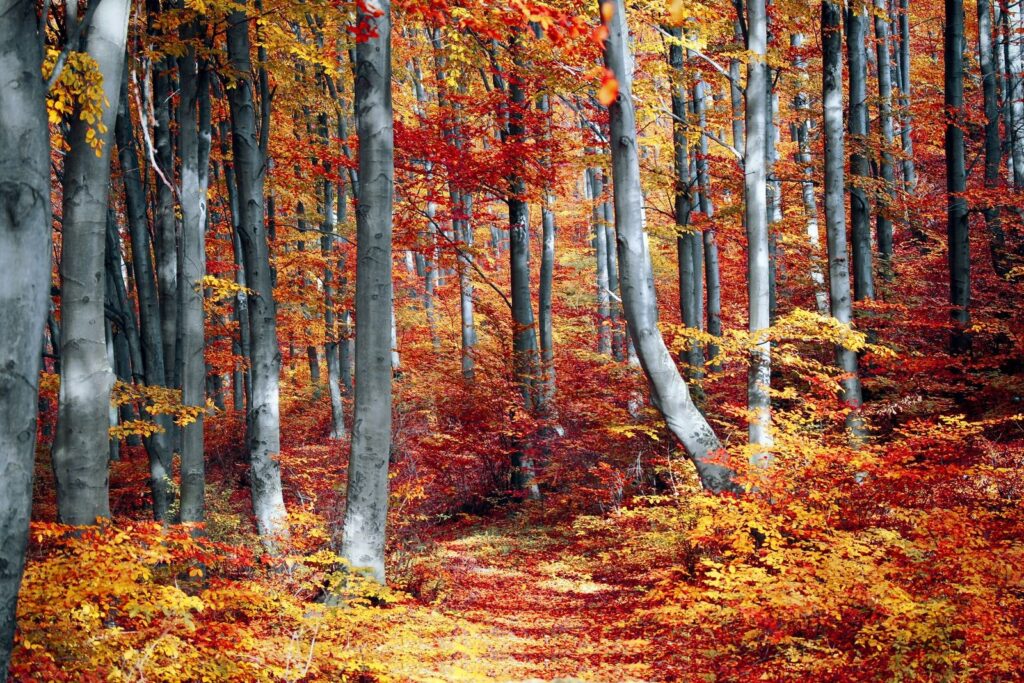
In autumn, chlorophyll production slows and the green fades. The carotenoids that were there all along then show through, which is why many leaves turn yellow. Reds and purples are different: anthocyanins are mostly made in autumn, and their production is tied to bright, sunny days and sugar building up in the leaf. Extension sources differ somewhat on which weather conditions give the best reds, so it is safest to say that autumn colour varies with the weather and the tree. Some plants, such as copper beech, look purple or red through the growing season because of non-photosynthetic pigments.
Things you can try or notice
- Hold a leaf up to the sky and look through it, then look at the same leaf from the front. Compare the colour of the light passing through with the colour reflected from the surface.
- Compare leaves of different ages on the same plant, such as new growth and older leaves, and see whether the shade of green differs.
- In autumn, watch the order of change on one tree. Yellows and oranges that were hidden by chlorophyll can show as the green fades, while reds are newly made.
- Look for plants that are not simply green, such as copper beech or purple-leaved varieties in gardens, and think about which pigments might be involved.
- On a sunny autumn day, look at leaves facing the light and leaves in shade on the same tree, and note any difference in redness.
Frequently asked questions
Do plants use green light at all?
Yes. A leaf absorbs a notable share of the green light that reaches it, and a 2009 study found that green light can drive photosynthesis efficiently deep inside a leaf, especially in strong light.
Why do leaves change colour in autumn?
Chlorophyll production slows and the green fades, revealing carotenoids that were already in the leaf. Many trees also make anthocyanins in autumn, which give reds and purples.
Are all plants green?
No. Plants with strong carotenoid or anthocyanin content can look yellow, orange, red or purple. Copper beech is a well-known example of a tree that stays non-green through the season.
Would a black plant do better?
Nobody knows for certain. Black leaves would absorb more light, but the ideas above suggest that more light is not the only limit. A flickering light supply, uneven light inside the leaf and the slow chemistry that follows all matter.
Closing thought
The simple part of the answer is settled: chlorophyll favours red and blue, and the leftover green is what we see. The deeper part, why evolution settled on a pigment that leaves green behind, is a live scientific question with a few promising answers and no final verdict.
Sources
- Why are leaves green?, The University of Tokyo (Ichiro Terashima)
- Green light drives leaf photosynthesis more efficiently than red light in strong white light: Revisiting the enigmatic question of why leaves are green, Plant and Cell Physiology (listing at the Australian National University research portal)
- Why Are Plants Green? To Reduce the Noise in Photosynthesis., Quanta Magazine
- Use Remote Sensing Data to Study Vegetation Dynamics, NASA Earthdata
- Reflected Near-Infrared Waves, NASA Science
- The Science Behind Autumn Leaf Color, Penn State Extension
- Leaf Color Change in Autumn, Wisconsin Horticulture, Division of Extension, University of Wisconsin-Madison
Last updated: November 2026. This article is general information, not scientific advice.