Why Do We Get Goosebumps?
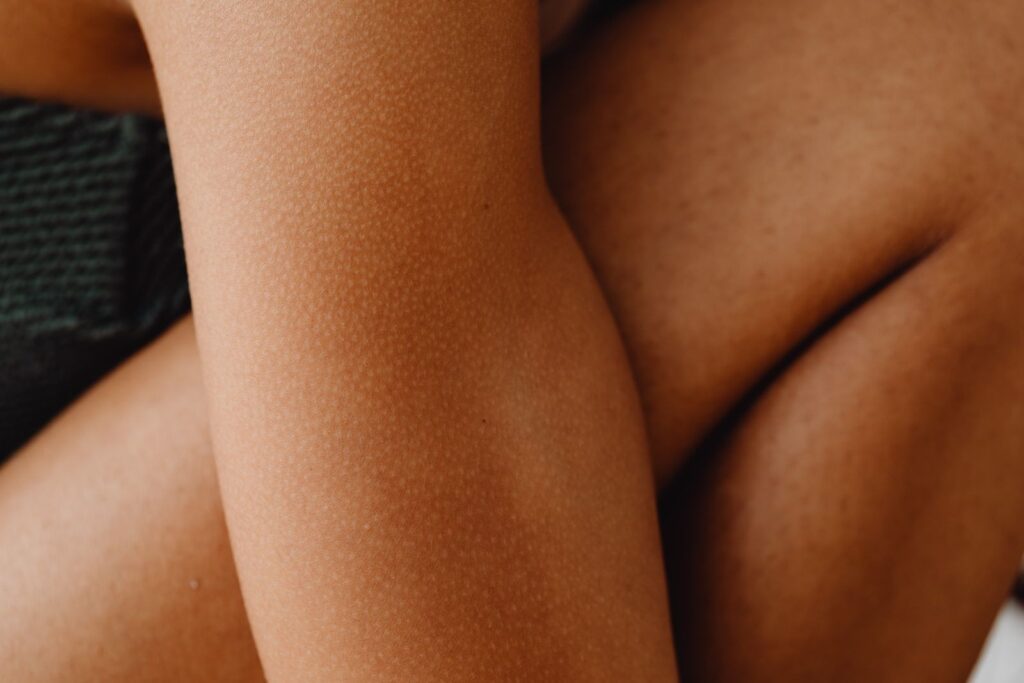
Short answer: Goosebumps appear when a tiny muscle at the base of each body hair tightens, pulling the hair upright and puckering the skin around it. The order comes from the same automatic nerve network that speeds up your heart when you are cold, startled or deeply moved. In furry animals the reflex thickens the coat and makes the animal look bigger, and in us it may still play a quiet part in looking after our hair.
Key takeaways
- Each bump is made by a small muscle called the arrector pili, which is attached to a hair follicle (the pocket of skin a hair grows from).
- The muscles are switched on by the sympathetic nervous system, the automatic wiring behind the fight-or-flight response.
- Cold, fear, stress and strong emotion all call on that same system, which is why such different moments end with the same bumpy skin.
- For furry mammals, raised hair traps warm air and makes the animal look larger to a rival.
- A 2020 Harvard-led study in mice found that the goosebump nerve and muscle also help control the stem cells that regrow hair.
- Goosebumps and “the chills” are not the same thing, and people often have goosebumps without noticing.
What is actually happening in your skin
Look closely at a goosebump and you will find a hair in the middle of it. That is the clue. Tiny muscles are attached to each hair, and when one of them contracts it pulls the skin into a shallow dip, so the patch around it rises into a bump. The same tug stands the hair up straight. George Bubenik, a physiologist at the University of Guelph, described the result in Scientific American as resembling the skin of a plucked bird.
The muscle is called the arrector pili. It is smooth muscle, the kind that works without you deciding anything, and it is wrapped in nerve fibres from the sympathetic nervous system. That system quietly runs jobs you do not manage on purpose, such as your heart rate and the widening of your pupils.
How it happens, step by step
- Something sets off your body’s alert system: a cold draught, a fright, a wave of strong feeling.
- Sympathetic nerves fire, and the body releases chemical messengers linked to stress, including adrenaline, which is made in two small glands that sit on top of the kidneys.
- The nerve fibres wrapped around each arrector pili muscle tell it to contract.
- The muscle shortens and tugs on the hair follicle.
- The hair stands upright, the skin beside it dips, and the skin around it rises into a bump.
- When the signal fades, the muscle relaxes and the skin goes smooth again.
Why cold and strong feelings share one reflex
Cold and emotion seem like very different triggers, but they arrive at the same switch. Bubenik explains that adrenaline is released when we feel cold or afraid, and also when we are under stress or feeling strong emotions such as anger or excitement. Goosebumps are only one sign of that release. Others on his list include sweaty palms, trembling hands, a racing heart and “butterflies” in the stomach.
So the skin is not judging whether you are chilly or thrilled. It is simply responding to an alert that many different situations can raise. Popular Science notes that a frightening film or story can set off the same nervous system response as a real threat, and that milder experiences, such as beautiful music or a moment of deja vu, can do it too. Bubenik adds that even a memory of an emotional event can be enough.
| Trigger | What the body is reacting to | What raised hair does for a furry animal | What it does for us |
|---|---|---|---|
| Cold | A drop in temperature | Thickens the layer of air held in the coat, which keeps heat in | Very little warmth, since our body hair is so sparse |
| Fear or threat | Danger, real or imagined | Makes the animal look bigger to a rival or attacker | No real change in size, just bumpy skin |
| Strong emotion | Moving music, big moments, vivid memories | Not clear | A visible sign of an aroused nervous system |
What goosebumps did for our furrier ancestors
To see the reflex doing useful work, watch an animal with a proper coat. In mammals with thick fur, raising the hairs expands the layer of air trapped next to the skin. Trapped air is a good insulator, in the same way a puffy jacket is warmer than a flat one, so a fluffed-up coat holds on to more body heat.
The second job is showing off. Bubenik’s example is a cat cornered by a dog: its fur stands on end, its back arches and it turns side-on, all of which make it look larger than it is.
Humans kept the muscles and the wiring but lost the coat. Our fine body hair cannot trap much air, and it certainly does not make anyone look bigger. That is why goosebumps are often described as a leftover: a reflex that keeps firing long after the fur it was built for has thinned out.
The music question: chills and goosebumps
Many people say a favourite song gives them goosebumps. Scientists have looked closely at that moment. In 2011, researchers at McGill University’s Montreal Neurological Institute reported in the journal Nature Neuroscience that pleasurable music releases dopamine, a brain chemical tied to reward. They tracked musical “chills” through changes in skin conductance, heart rate, breathing and temperature, and used two kinds of brain scan to watch what happened.
Two findings stand out. Dopamine release was greater for music people loved than for neutral music, and it also rose while listeners were anticipating the best part. The build-up and the payoff each get their own burst, much like tension and resolution in the music itself.
That study measured chills, though, not raised hairs, and the two turn out to be different things. More on that below.
What people get wrong about goosebumps
Myth: goosebumps and “the chills” are the same thing
The shivery, pleasant feeling known as a chill (or frisson) often arrives without any bumps at all. Jonathon McPhetres, a researcher who published several studies on goosebumps while at Durham University, told Popular Science that roughly half the time people report chills, their skin shows no goosebumps. He also says people frequently have goosebumps without noticing them.
Myth: surprise is what sets them off
In a 2024 study in the journal PLOS One, McPhetres and colleagues filmed volunteers’ skin while they watched videos. About half of the 80 people in the first experiment got goosebumps, but twist endings did not reliably produce more of them, and the feelings people reported explained only about 7 percent of the pattern. In a second experiment, 27 people watched the same video five times in a row. Seventeen got goosebumps at some point, and 10 of those still had them on the fifth viewing, even as they reported feeling less moved and more bored.
Myth: they are a completely useless leftover
This one is still being argued over, and the next section explains why.
Do goosebumps still do anything?
The most interesting recent answer comes from a team led by Ya-Chieh Hsu at Harvard University, working with Sung-Jan Lin at National Taiwan University. Their study, published in the journal Cell in 2020, looked at mouse skin under an electron microscope, a tool that reveals far finer detail than an ordinary light microscope.
They found that the sympathetic nerve does not only connect to the goosebump muscle. It also wraps around the hair follicle’s stem cells “like a ribbon”. Stem cells are the unspecialised cells that rebuild a tissue, in this case the ones that regrow the follicle and the hair. The findings fit together like this:
- A steady, low level of nerve activity keeps the stem cells poised and ready.
- Prolonged cold raises that nerve activity, which pushes the stem cells to regenerate the follicle and grow new hair.
- The muscle acts as a bridge. When the researchers removed it, the nerve pulled back and lost its link to the stem cells.
The team described a two-layer response to cold. Goosebumps are the quick fix, and new hair growth is the slow one. Earlier reports on the same project, covered by Science News in 2018, identified norepinephrine, a chemical messenger released by these nerves, as necessary for that hair growth.
Two cautions are worth keeping in mind. This work was done in mice, whose coats matter far more to them than our body hair does to us. And researchers do not agree on the bigger picture. McPhetres argues that human goosebumps should not be seen as purely a relic of hairier ancestors, while others still regard them as doing little for a mostly hairless species.
Frequently asked questions
Can you get goosebumps on purpose?
Not in the way you flex an arm. The muscles are run by the sympathetic nervous system, which handles involuntary jobs such as heart rate. What you can do is seek out a trigger, such as a cool breeze or music that reliably moves you.
Why do goosebumps spread across the whole body?
It depends on the trigger. According to research described by Popular Science, cold applied to one spot, such as the thigh, tends to bring out goosebumps across the body, while tickling produces a more local response.
Why do scary films give me goosebumps when I know I am safe?
Your alert system reacts faster than your reasoning. A frightening scene can trigger the same nervous system response as a genuine threat, complete with the release of stress messengers such as adrenaline, even though you are sitting on a sofa.
Do other animals get goosebumps?
Yes. The reflex is common in mammals with fur, where it fluffs the coat for warmth or for display. A cat puffing up in front of a dog is the same reflex you feel on your arms, only with much more hair to work with.
The bottom line
Goosebumps are a small, fast reflex with a long history. A tiny muscle tugs on each hair because an automatic nerve network has sounded an alert, whether the cause is a cold wind, a fright or a song that gets under your skin. In furry animals that tug keeps heat in and makes rivals think twice. In us it mostly shows on the surface, though mouse studies suggest the same nerves and muscles are also quietly helping to manage hair growth.
Sources
- Why do humans get “goosebumps” when they are cold, or under other circumstances?, Scientific American
- The real reason behind goosebumps, Harvard Department of Stem Cell and Regenerative Biology
- Getting goose bumps could boost hair growth, Science News
- Musical chills: Why they give us thrills, McGill University via ScienceDaily
- Piloerection persists throughout repeated exposure to emotional stimuli, PLOS One (via PubMed Central)
- Why you get goosebumps when you’re scared, or inspired, Popular Science
Last updated: November 2026.
This article is general information for curious readers, not medical advice.