Why Is the Sky Blue, and Why Are Sunsets Red?
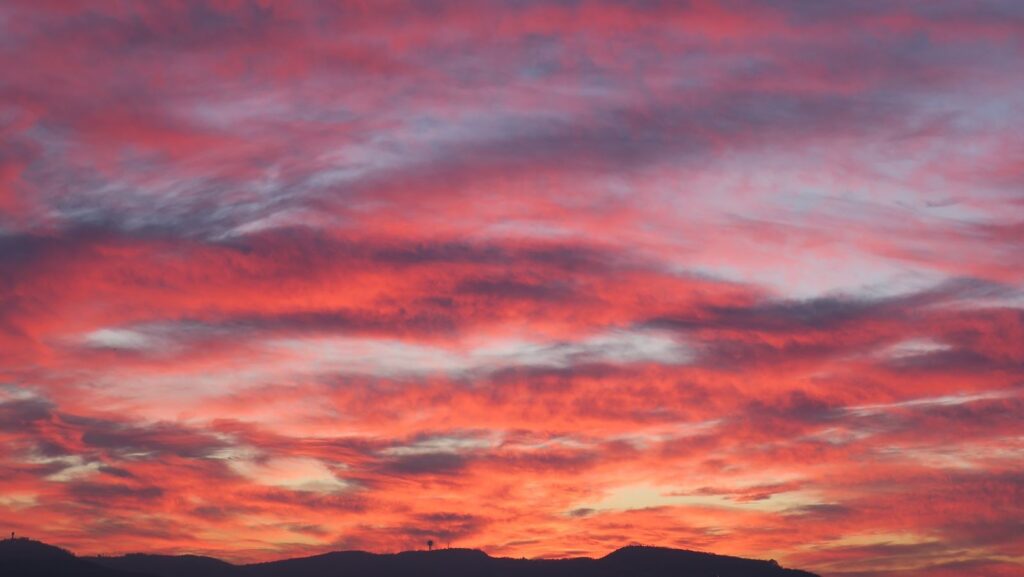
Short answer: Sunlight looks white, but it is a mix of every colour. Air molecules bounce the short, blue-end wavelengths around the sky far more than the long, red-end ones, so blue reaches your eyes from every direction overhead. At sunrise and sunset the light travels through much more air, most of the blue is scattered out of the beam, and the reds and oranges are what is left.
Key takeaways
- The blue sky is sunlight scattered by the gases in the air, mainly nitrogen and oxygen. It is not a reflection of the sea.
- Violet is scattered even more than blue, but the Sun gives off less of it and our eyes respond to it less, so the sky looks blue.
- Sunsets are red because low sunlight crosses a long stretch of atmosphere that strips out blue and violet along the way.
- Haze, smoke and dust change the picture: they can mute a sunset or, in some conditions, deepen its colours.
Sunlight is every colour at once
Light travels as waves, and the distance from one wave crest to the next is its wavelength. Our eyes read different wavelengths as different colours. Violet has the shortest visible wavelength, red has the longest, and the colours in between (blue, green, yellow, orange) blend smoothly from one to the next. Sunlight contains all of them, which is why it looks white and why a prism or a raindrop can pull it apart into a rainbow.
That detail is the whole story in miniature. If the atmosphere treats different wavelengths differently, a beam of white sunlight can arrive at your eyes with some colours removed and others added.
What scattering means
Scattering is what happens when light hits something and bounces off in many directions instead of carrying straight on. How much it scatters depends on the wavelength of the light and on the size and make-up of whatever it hits. The air is mostly nitrogen and oxygen molecules, and each molecule is far smaller than the wavelength of visible light.
When light meets objects that small, the shorter wavelengths are scattered much more strongly than the longer ones. Physicists call this Rayleigh scattering, after Lord Rayleigh, who studied it. Blue light is scattered far more than red, so as sunlight crosses the sky, blue gets knocked sideways and bounced again and again until it seems to come from everywhere. Red and yellow mostly go straight through. Look anywhere away from the Sun on a clear day and you are looking at blue light that has been redirected toward you.
Why not violet?
This is the natural follow-up question. Violet has a shorter wavelength than blue, so it is scattered even more. Why isn’t the sky violet?
Several things work against violet. The Sun puts out more of its energy as blue light than as violet. Some violet is absorbed high in the atmosphere. And human eyes are more sensitive to blue than to violet. Add these together and the sky we see is blue, with a hint of violet mixed in that we do not pick out as a separate colour. At high altitude, where there is less air between you and space, the sky overhead can look a deeper blue or even bluish-violet.
Why sunsets and sunrises turn red
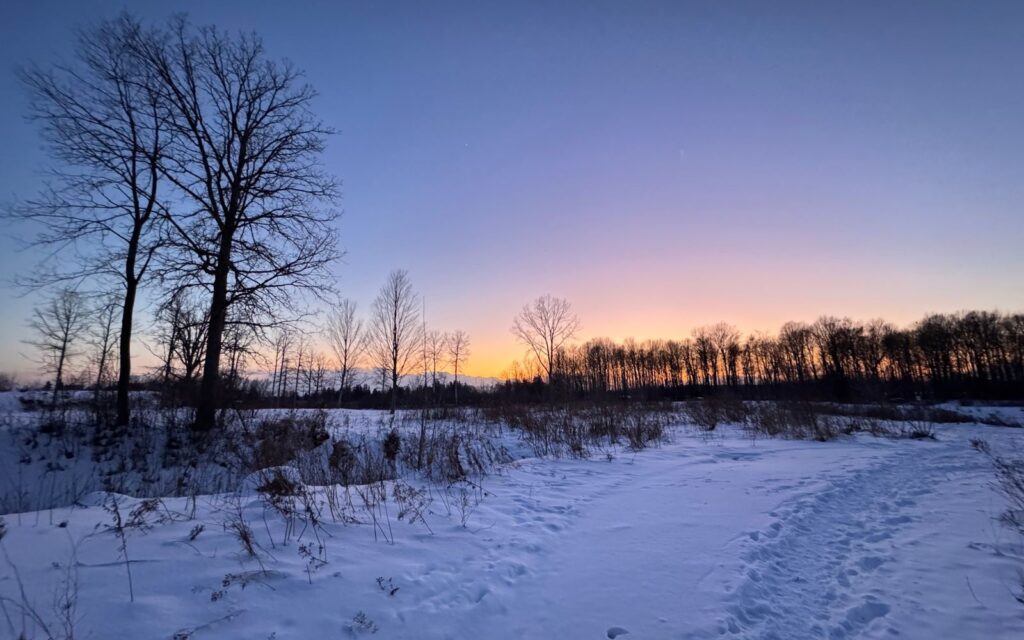
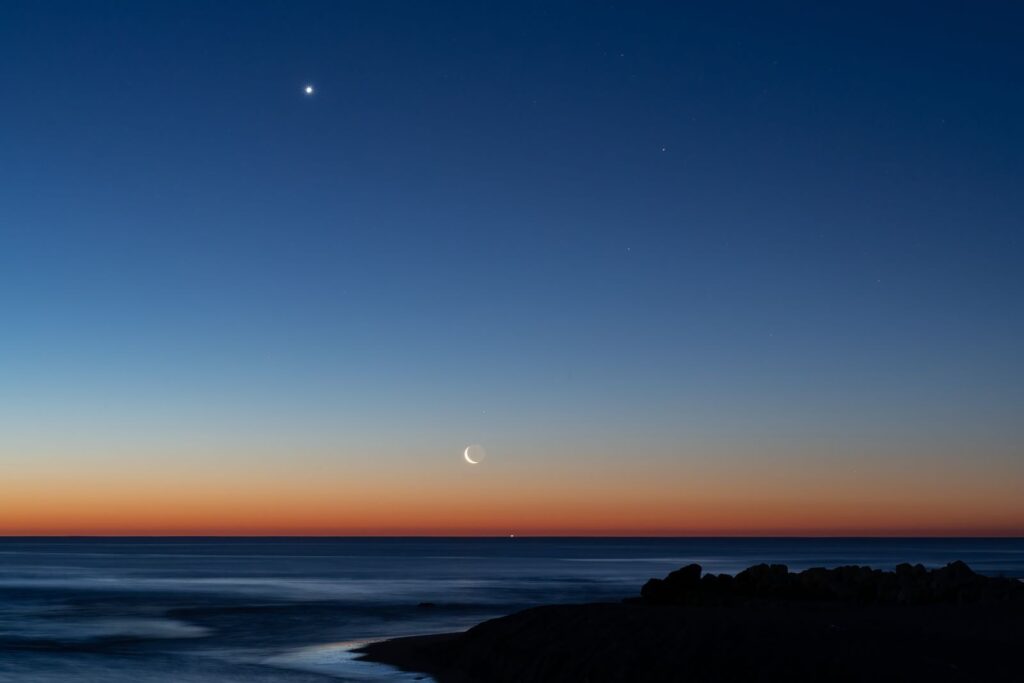
When the Sun is overhead, its light takes a fairly short path through the atmosphere. When it is low on the horizon, the same light has to cross far more air before it reaches you. Along that long path, blue and violet are scattered out of the beam over and over, away from your line of sight. They are not destroyed; they are sent off to light up the sky for someone else. What continues toward you is the longer-wavelength end of the spectrum: yellow, orange and red.
A neat way to put it, which a National Weather Service forecaster has used, is that sunsets are red because the daytime sky is blue. The same scattering that paints the sky overhead blue at noon is what removes the blue from the light you see at dusk.
The same thing happens at sunrise. The usual reason sunsets get more attention is simply that more people are awake for them.
You may also notice that the sky near the horizon looks paler than the sky overhead, even at midday. Light from that direction has crossed so much air, and been scattered so many times, that the colours blend back toward white.
What haze, smoke and dust do
Clean air is made of tiny molecules, and tiny molecules favour blue. Real air also carries larger particles: pollution droplets, dust, smoke and water vapour. Droplets from pollution are roughly half a micrometre to a micrometre across, which is close to the wavelength of visible light. Particles that size, in mixed sizes, scatter all colours much more evenly. The effect is a whitish or greyish sky and sunsets that wash out into pale yellows and pinks.
Haze also dims the light that reaches the ground. One NOAA forecaster notes that clean air is a key ingredient for vivid sunsets, which is why deserts and tropical regions have a reputation for them and big, hazy cities do not. In the same article, smoke from large wildfires is said to have muted sunsets across parts of North America in some years.
It is not always a simple story, though. NASA and NOAA education pages both say that extra dust, pollution or volcanic material can also intensify sunset reds, because particles help scatter away more of the remaining blue. A volcanic eruption can even leave glowing afterglows after sunset, when fine particles lofted high into the stratosphere catch sunlight after the ground below has gone dark. The result depends on how many particles there are, how big they are and how high they sit, which is why no two sunsets are quite the same.
Clouds matter too. The most memorable sunsets usually include some cloud, and high clouds in particular, because they catch the reddened light and show it to you. Low clouds and rain tend to dull the colours.
A common misconception: the sky is not the ocean’s reflection
Plenty of people were told as children that the sky is blue because it reflects the sea. It is a tidy idea, but it does not match how the science works. Every explanation in the sources below puts the blue in the air itself: sunlight is scattered by gases and particles in the atmosphere. If it were reflection from the sea, the sky above a desert or a mountain range, hundreds of kilometres from any ocean, would not be blue. It is.
The idea does have a grain of truth buried in it, which is that colours at the surface mix and reflect. NASA’s educational page notes that reflection and scattering from Earth’s surface adds white and reduces blue near the horizon. But that is a small tweak on top of the main effect, not the cause.
Other worlds make a good test of the idea. Mars has a thin atmosphere of mostly carbon dioxide with fine dust. According to NASA, its daytime sky looks orange or reddish, while the sky around the Sun at sunset looks blue-grey. The colour depends on what is in the air, not on a reflected ocean.
What you see and what is really happening
| What you see | What is really happening |
|---|---|
| Deep blue overhead at noon | Short wavelengths are scattered by air molecules in all directions, so blue light reaches you from every part of the sky. |
| Pale or whitish sky near the horizon | The light has crossed so much air and scattered so many times that the colours mix back toward white. |
| Red or orange Sun at dusk | The low Sun’s light crosses a long path of air, and most of the blue and violet is scattered out of the beam. |
| Dull, grey-yellow sunset in a hazy city | Larger particles scatter every colour fairly evenly, which washes the sky out and dims the light. |
| Glowing sky after the Sun has gone down | High clouds or fine particles far above the ground are still catching the reddened sunlight. |
Things you can try or notice
- Look at the sky at different angles on a clear day. It is usually paler toward the horizon than overhead.
- Compare a sunset after clear, dry weather with one on a hazy evening. Notice how the colours and the brightness of the Sun differ.
- Watch the clouds. High, thin clouds often glow longest after sunset, while low cloud decks tend to stay grey.
- If you travel to high ground, check whether the sky overhead looks a deeper blue than it does at sea level.
- Never look directly at the Sun, even when it is low and reddened. Watch the colours in the sky around it instead.
Frequently asked questions
Why is the sky blue and not violet?
Violet is scattered more than blue, but sunlight has less violet in it, some violet is absorbed high in the atmosphere, and our eyes are less sensitive to it. The mix we perceive is blue.
Why does the Sun look red when it is low?
Its light passes through more atmosphere, so more blue and violet is scattered out of the direct beam. The longer wavelengths are what remain.
Do pollution and smoke make sunsets redder?
Sometimes, but not always. Educational pages from NASA and NOAA say that dust, smoke or volcanic particles can intensify the reds. A NOAA forecaster’s article adds that heavy haze can also mute sunsets and leave them pale. It depends on the particles and how much light they let through.
Is the sky blue on other planets?
Not necessarily. It depends on the atmosphere. NASA says Mars has a thin, dusty, carbon dioxide atmosphere with an orange or reddish daytime sky.
Closing thought
One mechanism, scattering, explains the noon sky, the pale horizon and the glowing dusk. Once you know that blue is being spread across the sky and red is what is left over when the path is long, you can read the weather and the air quality in the colours overhead.
Sources
- Why Is the Sky Blue? (NASA Space Place, NASA Science for Kids), NASA
- Wave Behaviors, NASA Science
- Why Is The Sky Blue?, National Weather Service, Flagstaff
- Why Is the Sky Blue?, NOAA National Environmental Satellite, Data, and Information Service (NESDIS)
- The Colors of Sunset and Twilight, Stephen F. Corfidi, NOAA/NWS Storm Prediction Center
Last updated: November 2026. This article is general information, not scientific advice.