Why Does Ice Float on Water?
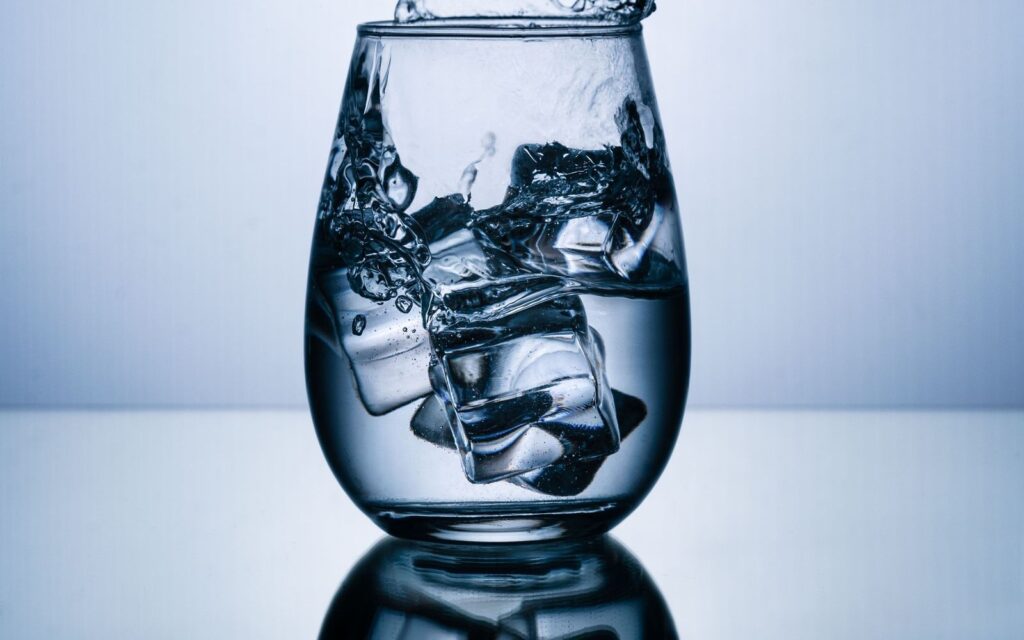
Short answer: Ice floats because frozen water takes up about 9 percent more room than the same amount of liquid water, so ice is less dense than the water around it. As water freezes, its molecules lock into an open, orderly framework held together by hydrogen bonds, and that framework has more empty space than the jumble of liquid water. Something less dense than the liquid it sits in is pushed to the top.
Key takeaways
- Ice is about 9 percent less dense than liquid water, so roughly a tenth of an ice cube sits above the waterline.
- Hydrogen bonds hold frozen water molecules in an open, hexagonal pattern with gaps in it.
- Liquid water is densest at about 4 degrees C (39.2 degrees F), not at its freezing point, which is why lakes freeze from the top down.
- That top-down freezing leaves liquid water under the ice, which matters a great deal for fish and other lake life.
- Almost every other liquid does the opposite: its solid sinks. Water is the odd one out.
What “floating” actually means
Whether something floats depends on one comparison: is it less dense than the fluid around it? Density is simply how much stuff is packed into a given space. A cork and a pebble can be the same size, but the pebble holds more matter in that space, so it sinks. Liquid water has a density, and so does ice. When ice is the lighter of the two, the surrounding water cannot help but push it up and out of the way.
What is surprising is not the rule but the result. In most materials the solid form is denser than the liquid form, because cooling makes molecules slow down and crowd closer together. Water breaks that habit.
Why frozen water takes up more room
A water molecule is one oxygen atom with two hydrogen atoms attached. The oxygen end of each molecule carries a slight negative charge and the hydrogen ends a slight positive one, so neighbouring molecules attract each other. That attraction is called a hydrogen bond, and water has a great many of them.
In liquid water the molecules tumble around constantly, and bonds keep forming and breaking. Molecules can slip into gaps and sit quite close together. In ice, each molecule settles into a fixed spot and bonds to its neighbours in set directions. The result is a regular, six-sided (hexagonal) crystal pattern. Hydrogen bonds point in particular directions, so the pattern cannot pack molecules as tightly as a jumbled liquid can. It holds them slightly farther apart, leaving open space inside the structure.
The U.S. Geological Survey puts the result in numbers: ice has about 90 percent of the density of liquid water, so freezing lowers density by roughly 9 percent, and about 10 percent of an ice cube or iceberg rides above the surface. The rest sits below, pushing aside its own weight in water.
The odd thing that happens above freezing
You might expect water to keep getting denser right down to 0 degrees C (32 degrees F) and then jump to a less dense solid. It does not. Liquid water is densest at about 4 degrees C (39.2 degrees F). Below that, as it cools toward freezing, it actually gets slightly less dense again.
The usual picture is a tug of war. Cold favours the open, ice-like arrangements, and warmth favours more compact, jostling ones. Near 4 degrees C the two effects balance, and the packing is tightest. Researchers at Temple University reported in 2026, in the journal Science Advances, a computer-model study of this balance. Their release describes water’s density behaviour as a long-standing puzzle and says the answer lies in competing order and disorder at different distance scales in the hydrogen-bond network. In plain terms, the broad idea (open ice-like structures versus heat) has been around for a long time, and the finer details are still being worked out.
| Temperature of liquid water | What happens to its density |
|---|---|
| Warm, cooling toward 4 degrees C | Gets denser, so cooler water sinks |
| About 4 degrees C (39.2 degrees F) | Densest point |
| 4 degrees C down to 0 degrees C | Gets slightly less dense, so the coldest water rises |
| Freezes at 0 degrees C | Jumps to about 9 percent less dense as ice, which floats |
Why lakes freeze from the top down
Put the pieces together and a lake’s winter becomes easy to follow. In autumn the surface water cools and, being denser, sinks, pushing deeper water up to be cooled in turn. This mixing continues until the whole lake is near 4 degrees C. After that, further cooling makes the surface water lighter, not heavier. It stays on top, forms a stable layer, and eventually freezes. Ice then forms a lid.
The USGS notes that if water were densest at its freezing point, the coldest water would settle at the bottom and a lake could freeze from the bottom up. Water is also a good insulator, so a lake frozen that way might not melt fully in summer. A lake that freezes from the top keeps a lid of ice that slows heat loss from the water below, and the Children’s Museum of Indianapolis notes that fish can survive under it. The USGS goes further and calls this behaviour critical for life on Earth.
One caution: the story above is a simplified picture of a calm lake. Real lakes vary with depth, wind and weather, so treat it as the basic outline rather than a forecast for any particular pond.
Common misconceptions
“Water gets denser all the way to freezing”
This is the intuitive guess, and it is wrong for water. The density peak is at about 4 degrees C, and that is exactly why the coldest water ends up at the top of a lake.
“Ice floats because it is full of air bubbles”
Ice can contain trapped air, and the USGS notes that air affects the density of a particular piece of ice. But the air is not the reason ice floats. The open crystal pattern is. Even bubble-free ice is about 9 percent less dense than the water it came from.
“Cold things are lighter, so cold water floats”
Not in general. For most of the temperature range, cold water is denser than warm water. Only between 4 degrees C and freezing does the trend reverse.
Water versus most other liquids
Water is far from alone in having a strange solid, but it is rare among everyday materials. A few other substances also expand when they freeze: Los Alamos National Laboratory reports that gallium, a metal that melts in a warm hand, expands by 3.1 percent as it solidifies. Water’s 9 percent is bigger still. For the ordinary run of materials the solid is denser than its liquid and sinks in it. BBC Science Focus notes that density usually drops with each change from solid to liquid to gas, which makes ice an unusual case.
The USGS adds a neat curiosity: ice made from heavy water, which contains a heavier form of hydrogen, is denser than ordinary water and sinks in it.
Things you can try or notice
- Drop an ice cube in a clear glass of water and look from the side. You should see most of it underwater and a small part above the surface, roughly a tenth.
- Mark the water level on a clear plastic container, freeze it with some empty room at the top, and compare. The ice should stand higher than the line you marked. Use plastic, not glass, and never seal a full container tightly: BBC Science Focus describes the pressure from freezing water in a sealed space as huge.
- Put one ice cube in plain water and one in very salty water. Salt raises the density of water, according to the USGS, so the cube should ride a little higher in the salty glass.
- On a cold day, look at a frozen puddle or pond edge from the shore. Ice on top, liquid below. Stay off the ice itself, as the Children’s Museum of Indianapolis advises.
Frequently asked questions
Why do bottles of water burst in the freezer?
Because freezing water expands by about 9 percent. If the bottle is full and rigid, the growing ice has nowhere to go and pushes against the walls.
Does ice float in seawater too?
Yes. Dissolved salts make seawater denser than fresh water, so ice floats even more easily. The USGS describes sea ice as ice floating at the ocean surface.
Is the 4 degrees C puzzle solved?
The broad explanation, a balance between open ice-like arrangements and heat, is well established. Temple University’s 2026 release describes the finer details as a long-standing puzzle that new modelling is tackling, so treat the deepest level of explanation as an active research topic.
Would lakes freeze solid if ice sank?
The USGS says a lake could freeze from the bottom up if water were densest at its freezing point, and it might not fully thaw in summer. The USGS calls the actual behaviour critical for life on Earth.
A small oddity with big consequences
An ice cube bobbing in a drink is the visible edge of a chain of cause and effect: hydrogen bonds, an open crystal, a density peak at 4 degrees C, and lakes that freeze from the top and stay liquid below. It is a good example of how a tiny molecular detail shapes the living world.
Sources
- Water Density, U.S. Geological Survey (USGS Water Science School)
- Why Does Ice Float?, The Children’s Museum of Indianapolis
- Why does ice form on the top of a lake?, Science Questions with Surprising Answers (Dr. Christopher S. Baird, West Texas A&M University)
- Temple researchers combine AI and quantum physics to unlock a long-standing mystery of water, Temple University College of Science and Technology
- Why does ice float on water?, BBC Science Focus Magazine
- Gallium Ga 31, Periodic Table of Elements, Los Alamos National Laboratory
Last updated: November 2026. This article is general information, not scientific advice.