How Does Lightning Form, and Why Does It Thunder?
Short answer: Lightning is a giant spark. Inside a storm cloud, collisions between ice particles sort electric charge into separate layers, and when the difference grows too large the air briefly stops insulating and a current surges through it. That surge heats the air in its path to tens of thousands of degrees, and the air bursts outward with a bang we call thunder. Light reaches you almost instantly, but sound is slow, so the flash always comes first.
Key takeaways
- Charge builds up when ice crystals and small, soft hailstones called graupel collide inside strong updrafts, with the particles trading charge and then being sorted by weight.
- Scientists still do not fully agree on every step of how that charge transfer works, or on exactly how the air first breaks down.
- Thunder is the sound of superheated air expanding. It rumbles because the sound arrives from many points along a long, crooked channel at slightly different times.
- Sound covers roughly a kilometre in three seconds, or a mile in five, so counting from flash to bang gives a rough distance.
- “Heat lightning” is ordinary lightning from a storm too far away to hear, and lightning can and does strike the same place again.
- The National Weather Service message is short: when thunder roars, go indoors.
The cloud is a charge factory
A thunderstorm cloud is a tall, churning column. Strong updrafts, which are streams of rising air, carry water droplets far above the level where the temperature falls below freezing. Up there the cloud holds a mix of tiny ice crystals, droplets of water that are still liquid even though they are colder than 0 °C, and graupel, which are slushy pellets of ice a little like soft hail.
According to the National Severe Storms Laboratory, when graupel and ice crystals bounce off one another, they swap electric charge. One kind ends up with a positive charge and the other with a negative charge. Because graupel is heavier, it tends to fall or hang lower in the updraft, while the lighter crystals are carried upward. That sorting is the key step. The result is a cloud with regions of opposite charge, one above the other, built up in the same storm that is raining or hailing below.
What is still debated
This is the broad picture, but it is not a closed case. The NSSL says plainly that the exact physics of how charge transfers in these collisions is “not completely understood,” and that the way air first breaks down to start a lightning flash is also poorly understood. A second process, involving freezing droplets in an electric field, may add to the first. So the early steps remain an active research question.
From charge to flash: the leader and the return stroke
Air is normally a very good insulator. Once the voltage between cloud and ground, or between two parts of the cloud, grows large enough, the air gives way. The NSSL notes that these voltages can reach 100 million to a billion volts.
For a typical cloud-to-ground strike, the story runs in four steps.
- A faint channel of charge, called a stepped leader, creeps downward from the cloud. It advances in short jumps rather than one smooth line, which is why it zigzags and branches.
- As it nears the ground, objects below send up their own short streamers of charge to meet it.
- When a streamer from below and the leader from above connect, a complete conducting path exists.
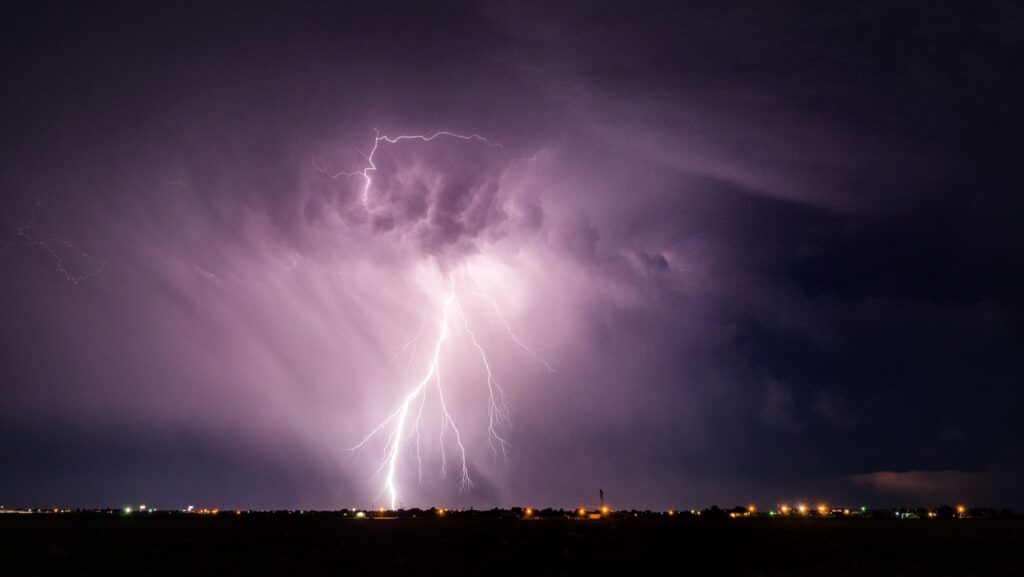
- A surge of current races back up that path. This is the return stroke. It is the bright flash your eyes actually see, and it is over in a few thousandths of a second.
Why the flash is so hot, and how that makes thunder
The channel the current follows is narrow, and a great deal of energy is dumped into it very fast. The National Weather Service says the air in the channel can reach about 50,000 °F, roughly 28,000 °C, which it compares to about five times the surface temperature of the Sun. The NSSL gives a wider range for the surrounding air, from about 18,000 to 60,000 °F.
The air has almost no time to expand while it is being heated, so the pressure inside the channel shoots up. Then the air blasts outward. According to the NSSL, for roughly the first 10 yards the expansion travels as a shock wave, which is a pressure front moving faster than ordinary sound. After that it settles into a normal sound wave, and that is the thunder you hear. The National Weather Service adds that the heated air then cools and contracts quickly, which is part of what makes the sound.
Why you see lightning before you hear thunder
The flash and the bang start at the same moment. But NASA gives the speed of light as 186,000 miles per second, so you see the flash almost at once, while sound crawls along at about 1,100 feet per second on a standard day at sea level. That is about 335 metres per second, which works out to roughly three seconds per kilometre, or about five seconds per mile. Sound speed varies with temperature, so these are rules of thumb.
That gives the familiar counting trick. Count the seconds from the flash to the first sound, then divide by five for miles or by three for kilometres.
| Seconds counted | Roughly how far away |
|---|---|
| 0 to 1 | Very close |
| 5 | About 1 mile (1.6 km) |
| 15 | About 3 miles (5 km) |
| 30 | About 6 miles (10 km) |
| 50 | About 10 miles (16 km), near the usual limit for hearing thunder |
The count gives a rough distance for one flash. It does not tell you whether the storm is approaching.
Why thunder rumbles
A lightning channel is not a point. It is long and bent. Each stretch of it makes its own sound wave, and those waves travel to you over different distances. The nearest part reaches you first, and the farther parts arrive later, so one instant of lightning is stretched into a longer stretch of sound.
That is also why close and distant thunder sound so different. The National Weather Service says a sharp crack or click suggests the channel passed close by, while a long rumble suggests the lightning was at least several miles away. The National Weather Service adds that the loud boom sometimes heard comes from the main channel as it reaches the ground.
Two common misconceptions
“Heat lightning”
On a warm summer night you may see silent flickers on the horizon and call it heat lightning. According to the NSSL, that is just ordinary lightning from a storm too far away for its thunder to reach you. The name stuck because it is most often noticed in summer.
“Lightning never strikes twice”
The National Weather Service lists this as a myth. Lightning often strikes the same place again, especially a tall, pointed, isolated object. The agency gives the Empire State Building as an example, hit on average 23 times a year.
| What you see or hear | What is really happening |
|---|---|
| A bright flash, then a bang a few seconds later | Light arrives almost at once. Sound takes about 3 seconds per kilometre. |
| A sharp crack | The channel passed nearby. |
| A long rumble | Sound is arriving from many points along a long, distant channel. |
| Silent flickers on the horizon | A faraway storm, with the thunder too distant to hear. |
| A flash with no rain falling where you are | Lightning can strike miles from the storm centre, so the storm may still be close enough to matter. |
What the National Weather Service says to do
This section is general safety information, not personal advice for any particular situation. The National Weather Service summarizes its guidance in one line: when thunder roars, go indoors. If you can hear thunder, you are close enough to be at risk, and many lightning injuries happen to people who waited too long to move.
- Large, substantial buildings and hard-topped vehicles count as safe shelter. Rain shelters, small sheds and open-sided vehicles do not.
- Indoors, it advises staying away from plumbing, anything plugged into an outlet, and corded phones, and keeping away from doors and windows.
- It recommends waiting 30 minutes after the last thunder or lightning before going back outside, because many people head out as soon as the rain eases.
Things to try or notice
- Next time you are safely indoors during a storm, count from flash to thunder and convert the number to miles or kilometres.
- Notice whether a given bang is a crack or a rumble, and compare that with your count.
- On a clear, warm evening, look for distant silent flashes on the horizon and ask yourself what is really going on.
- Notice which tall, isolated objects stand out in your neighbourhood, since those are the kinds of places that get struck repeatedly.
Frequently asked questions
How hot is a lightning bolt?
The National Weather Service says the air in the channel can reach about 50,000 °F, and the NSSL gives a range of about 18,000 to 60,000 °F for the air around it.
How far away can you hear thunder?
The National Weather Service says thunder can usually be heard up to about 10 miles from the strike.
Can lightning strike when it is not raining?
Yes. The National Weather Service calls the idea that you are safe without rain a myth. Lightning can strike more than three miles from the centre of a storm, and bolts from the blue can land 10 to 15 miles away.
Is the five-seconds-per-mile rule exact?
No. NASA notes that the speed of sound depends on the temperature of the day, so the rule is an approximation.
Before you go
Lightning is the end of a long chain of ordinary physics: collisions, charge sorting, a breakdown of air, and a burst of heat. Experts are still working out the first links. The last link, the sound, you can measure yourself with a clock and a little arithmetic.
Sources
- Severe Weather 101: Lightning FAQ, NOAA National Severe Storms Laboratory
- Understanding Lightning: Thunder, National Weather Service (NOAA)
- Lightning Myths, National Weather Service (NOAA)
- Overview: Lightning Safety, National Weather Service (NOAA)
- Lightning Strike, NASA Glenn Research Center
Last updated: November 2026. This article is general information, not scientific or safety advice.