Why Do Birds Fly in a V?
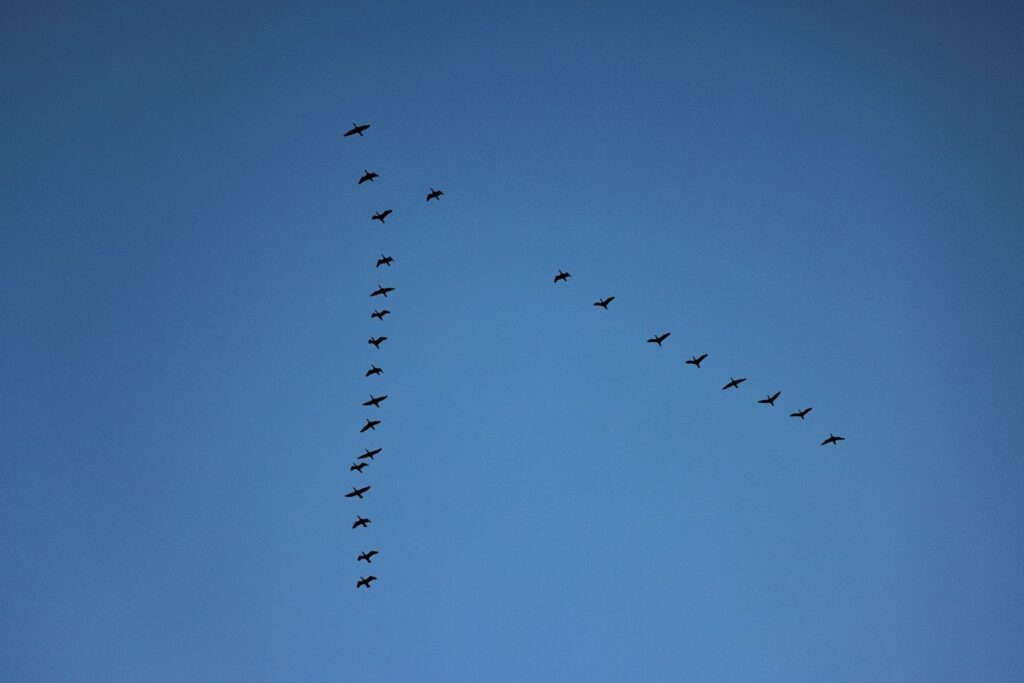
Short answer: Mostly to save energy. Each flying bird leaves a patch of rising air just behind and to the side of its wingtips, and a bird that sits in that patch gets a small free lift, so it can work less. The slanted lines also let every bird keep its neighbours and the leader in view, which helps the flock stay together.
Key takeaways
- A flapping wing pushes air down behind it and leaves rising air, called upwash, off to the sides. The V puts each follower in that rising air.
- Trackers on a flock of northern bald ibises showed the birds do not just sit in the right spot. They also time their wingbeats to match the air coming off the bird ahead.
- The front bird gets no help, so the lead changes. Tracked ibises swapped places in pairs and matched their time in front almost evenly.
- Measured savings are real but modest, roughly a tenth of a bird’s flying effort in the best-known studies, not the “half” that is often repeated.
- The trick suits big birds with slow wingbeats, such as geese, swans, cranes and pelicans. Small songbirds do not fly this way.
The free lift hiding behind a wingtip
To stay in the air, a wing has to push air downward. That downward-moving air right behind a bird is called downwash. It is the worst place for a follower to be, a bit like trying to climb a down escalator.
At the tips of the wings something different happens. Air curls around each tip and trails away in a spinning tube called a wingtip vortex. On the outer side of that spinning tube the air is moving upward. This is the upwash. A bird that places one wing in it is standing on the up escalator instead: the rising air holds it up a little, so it needs to flap less hard to stay level.
That good air is not directly behind the bird in front. It is behind and off to one side. Line up several birds, each tucked behind and beside the next, and you get a diagonal line. Put one on each side of the leader and you have a V.
Aircraft feel the same effect. In a 2003 NASA test, an F/A-18 jet flew about 200 feet behind a much larger DC-8, inside the airflow trailing from its wingtip, and burned 29 percent less fuel. NASA’s own account of the test pointed to migrating birds as the model.
What tracking studies of real flocks found
For a long time the energy idea rested on calculations. Four studies put it to the test.
| Year | Birds | How they were studied | What it showed |
|---|---|---|---|
| 1988 | Canada geese | Formations filmed and their geometry measured | Spacing fitted both energy saving and a clear view of the leader, with energy judged the main reason |
| 2001 | Great white pelicans | Heart-rate monitors worn in flight | Birds further back had lower heart rates than the leader |
| 2014 | 14 young northern bald ibises | GPS and motion loggers on every bird for 43 minutes of migration | Birds sat in the upwash and timed their flaps to it |
| 2015 | The same ibis project | Loggers recording who led and who followed | Birds took turns in front, matched in pairs |
The pelicans: a slower heartbeat at the back
A heart works harder when its owner does, so heart rate is a handy stand-in for effort. When great white pelicans wore heart-rate monitors in 2001, the birds further back in the V had lower heart rates than the bird in front. Audubon’s summary of that study puts the saving at up to 11 percent.
The ibises: every wingbeat recorded
The most detailed look came from a conservation project. Fourteen young northern bald ibises were hand-reared at Vienna Zoo and taught to follow a microlight aircraft along a migration route to wintering grounds in Italy. Each bird carried a small logger, built at the Royal Veterinary College in London, combining GPS with motion sensors. The devices could place a bird within the flock to about 30 centimetres, and they recorded every wing flap during 43 minutes of migratory flight.
The results, published in the journal Nature in 2014, showed two things. First, the birds really did hold the positions that theory says are best for catching upwash. Second, they matched their flapping to it. A bird in a V position beat its wings so that its wingtip followed the same path through the air as the wingtip of the bird ahead, which kept it in rising air through the whole stroke. When a bird ended up directly behind another, it switched to the opposite timing, which reduced the amount of downwash it had to fly through.
How birds take turns in the lead
The bird at the point of the V has nobody’s upwash to ride. It does the hardest work, and no bird can do it for a whole journey. So the lead changes: a tired front bird drops back and another moves up, much as cyclists in a pack rotate the rider at the front.
That raises an awkward question. If following is easier, why would any bird volunteer to lead? A 2015 study led from the University of Oxford used the ibis flock to find out. The 14 birds, each carrying a 23-gram logger, were tracked while migrating from Salzburg in Austria to Orbetello in Italy behind a powered parachute. They flew in shifting formations of 2 to 12 birds.
On average each ibis spent 32 percent of its time flying in another bird’s updraft, and a matching share of time leading. The swapping happened mostly in pairs: one bird led while a partner followed, then they traded, and the two kept their times closely balanced. The researchers found no sign of freeloaders that took the easy position without paying it back.
The stakes are high: the Oxford team noted that up to 35 percent of young birds may die of exhaustion on their first migration.
Seeing and hearing each other
Energy is not the whole story. In the 1988 goose study, biologist John Badgerow weighed two explanations against each other. One was aerodynamics. The other was sight: in a V, birds on both arms have an unblocked view of the leader, who sets the course, so changes in speed and direction can pass quickly down the lines. He concluded that both play a part, with energy the bigger one.
His measurements also showed how untidy real life is. The ideal gap between one bird’s wingtip and the next was a precise 0.16 metres, and turbulence kept knocking the geese off it. In practice they collected only about a fifth of the saving possible on paper.
Sound helps too. Geese are at their noisiest in flight, and the honking keeps the flock in contact and helps coordinate position changes.
Which birds do it, and which do not
V flying is a habit of large birds that travel in flocks. Canada geese are the best-known example. Swans, cranes, cormorants, pelicans, ibises, some ducks and flamingos do it as well.
Size is the reason. Big birds flap slowly and steadily, so the air they leave behind is orderly enough for a follower to use. Small birds flap fast and unevenly, and their wake breaks up too quickly to ride. Hummingbirds and sparrows are simply too small to gain from it, and most small migrants travel in loose flocks with no fixed shape.
There are in-between cases. A 2019 study that tracked shorebirds in three dimensions, including dunlins and marbled godwits, found that birds in big flocks tended to sit about one wingspan to the side and one and a half wingspans behind a neighbour. The researchers called this pattern a compound V.
Starlings do something else entirely. Their swirling evening clouds, called murmurations, are not migration flights and have no leader. Each bird reacts to the birds around it, often when a predator such as a falcon is near.
What people get wrong
- “The leader is the boss.” The front bird is taking a shift, not giving orders. In the tracked ibis flock, the lead changed hands again and again.
- “Geese use half the energy in a V.” This figure is widely repeated, but the measured numbers are smaller: up to about 11 percent in the pelican study, and estimates of 10 to 14 percent for geese.
- “The birds behind are slipstreaming.” Not quite. The spot straight behind another bird is the bad air. The benefit comes from being off to the side, in the rising air beyond the wingtip.
Spot it yourself
Next time a flock passes over, try this:
- Look at the overall shape. Is it a V, a single slanted line, or a ragged bunch?
- Check where each bird sits. In a V, no bird should be directly behind another. Each is offset to one side.
- Watch the front bird for a minute or two. You may see it slide back along one arm while a neighbour takes over.
- Listen. With geese, note whether the calling picks up when the shape changes.
Frequently asked questions
How much energy does flying in a V really save?
Less than the popular claims suggest, but enough to matter. The pelican heart-rate study pointed to a saving of up to 11 percent, and estimates for geese run from 10 to 14 percent.
Is the bird at the front the strongest?
Not necessarily. The front is simply the most tiring place, so birds rotate through it. The tracked ibises shared the job closely in pairs, though in small goose families the more experienced fliers tend to lead more often.
Why do geese honk so much while flying?
Calling keeps the flock in touch and helps birds coordinate when they shift places. Geese are more vocal in the air than at any other time.
Why don’t small birds fly in a V?
Their quick, irregular wingbeats leave a messy wake that fades fast, so there is no steady rising air for a follower to use. Many small birds travel in loose groups instead.
The bottom line
A V of geese is a flock sharing the cost of a long trip. Each bird behind the leader rides the rising air off a neighbour’s wingtip, the hard job at the front is passed around, and the slanted lines keep everyone in sight and earshot. And thanks to loggers small enough for a bird to carry, we know the birds go further still, adjusting their own wingbeats to air they cannot see.
Sources
- How birds fly in V formation, EarthSky
- Study Explains Why Birds Fly in V-Shaped Formation, Sci.News
- One good turn: Birds swap energy-sapping lead role when flying in v-formation, University of Oxford via ScienceDaily
- Why Do Birds Fly in a V Formation? Breaking Down a Brilliant Migration Hack, National Audubon Society
- NASA Sky Surfing for Fuel Economy, NASA
- Why Do Geese Fly in V Formations?, JSTOR Daily
- Why do geese fly in V-formation? The science behind the sky’s most iconic shape, Wildfowl and Wetlands Trust
- Nature curiosity: Why do some birds fly in a V formation?, Forest Preserve District of Will County
Last updated: November 2026.
This article is general information for curious readers, not professional advice.