Why Is the Night Sky Dark?
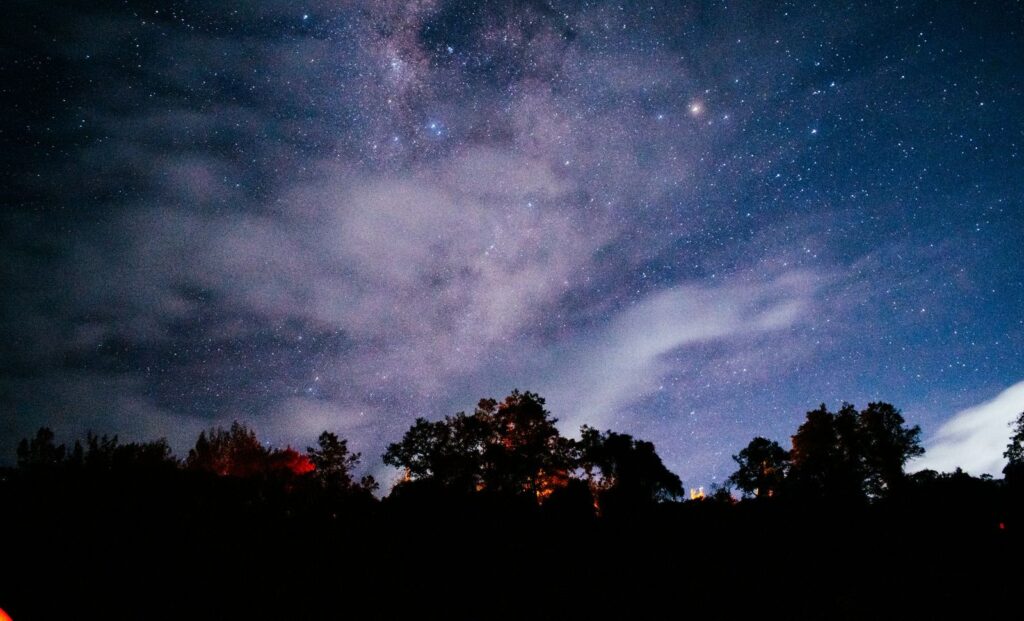
Short answer: The night sky is dark because the universe has not been around forever, and light takes time to travel. Only the light that has had time to reach us since the universe began can light up our sky, and that is nowhere near enough to fill it. On top of that, the expansion of space has stretched the oldest light of all into microwaves, which our eyes cannot see.
Key takeaways
- If the universe were endless, unchanging and packed with stars forever, the whole sky should blaze as brightly as the surface of the Sun. This puzzle is known as Olbers’ paradox.
- The main fix is time. The universe is about 13.8 billion years old, and light moves at a fixed speed, so light from very distant stars simply has not arrived yet.
- The oldest light in the universe is still all around us, but expansion has stretched it into invisible microwaves, called the cosmic microwave background.
- City skies look washed out for a different, local reason: artificial light scatters in the air and drowns out faint stars.
The puzzle: a sky full of stars should be bright
“It is dark because the Sun has set” explains why night differs from day. It does not explain why all the other suns in the sky, added together, fail to light up the night.
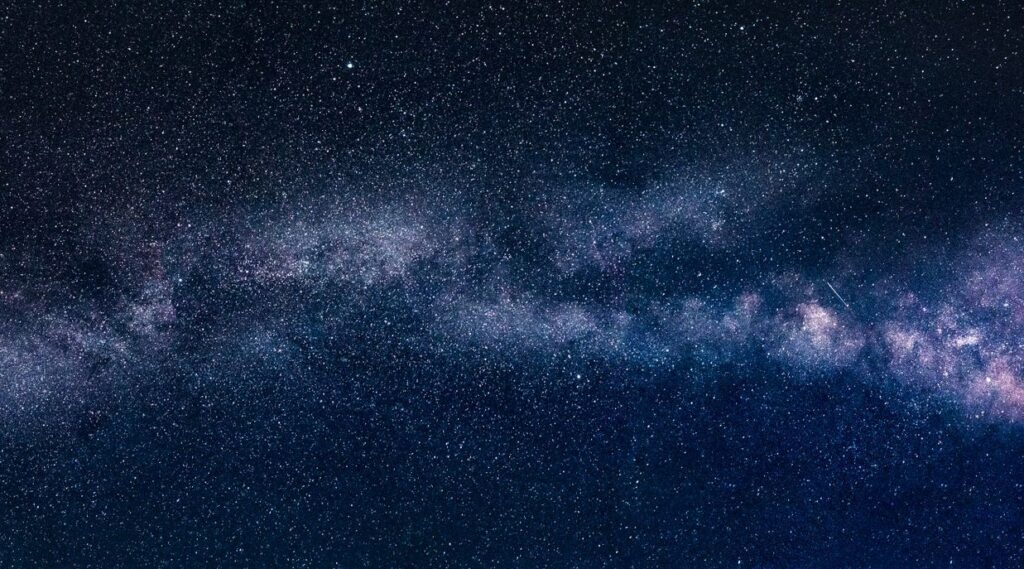
Picture yourself standing deep inside a very large forest. Whichever way you look, your eye lands on a tree trunk. There are gaps between the near trees, but farther trees fill them in. Now swap trees for stars. In a universe that goes on forever and is filled with stars, every direction you look should end on the glowing surface of a star. An astronomy course at Penn State puts the result plainly: the entire sky would be as bright as the surface of the Sun.
You might object that distant stars are faint. True, but a star twice as far away looks only one quarter as bright, yet a larger slice of space farther out holds more stars, in exactly the proportion needed to make up the difference. Each layer of the universe, near or far, would add the same glow, and endless layers would add up to a dazzling sky.
The German astronomer Heinrich Olbers wrote about this problem in Bremen on May 7, 1823, and his name stuck to it, although he was not the first to notice it. A paradox is a sound-looking argument that ends in an obviously wrong answer, so one of the starting assumptions must be wrong.
Early answers that did not work
Olbers had his own solution: dust or some other material between the stars soaks up the distant starlight. The astronomer John Herschel pointed out the flaw. Anything that absorbs that much light warms up, and warm material glows. In an endless, star-filled universe, the dust would heat until it shone as brightly as the stars it was hiding.
| Proposed explanation | The idea | Does it hold up? |
|---|---|---|
| Dust blocks the light | Material between the stars absorbs distant starlight | No. The dust would heat up and glow just as brightly. |
| Distant stars are too faint | Light spreads out and weakens with distance | No. More distant layers hold more stars, which cancels the dimming. |
| Stretching of light alone | Expansion shifts starlight out of the visible range | Not by itself. It helps, but it is not the main reason. |
| Finite age and finite light speed | Distant light has not had time to arrive, and stars do not last forever | Yes. This is the accepted main answer. |
The real answer, part one: the universe has a birthday
Light is fast, but not instant. According to NASA, it travels about 186,000 miles (300,000 kilometers) every second. That makes every look at the sky a look into the past. Sunlight takes about 8.3 minutes to reach us. Light from the nearest star beyond the Sun, Proxima Centauri, takes about 4.3 years. Light from the Andromeda galaxy takes 2.5 million years.
Now add the second fact: the universe began about 13.8 billion years ago. Light from anything so far away that its journey would take longer than that has not reached us. However big the universe really is, we can only see the part whose light has had time to get here. Beyond a certain distance there are, in effect, no trees in our forest to see yet, and the gaps stay dark.
The first person to publish this idea was not an astronomer. The writer Edgar Allan Poe gave a public lecture in New York on February 3, 1848, and printed his thoughts later that year in a work called Eureka. He suggested that the dark gaps could be explained if the background were so far away that no light from it had reached us at all.
Part two: stars do not shine forever
There is a second limit. Stars and galaxies have lifetimes. They switch on, shine and eventually fade. So the universe has never held enough burning stars, for long enough, to flood all of space with light.
In 1964 the astronomer Edward Harrison showed that the limited age of stars is the main thing keeping the night sky dark. He later noted that Lord Kelvin had proposed the same idea back in 1901. Observations in the 1980s confirmed the picture that Poe, Kelvin and Harrison had built.
Part three: the oldest light has been stretched out of sight
Here is the twist: the sky really is glowing in every direction. We just cannot see it.
The early universe was hot, dense and foggy. Light could not travel far before bouncing off loose electrons, the tiny charged particles that today sit inside atoms. A few hundred thousand years after the beginning (NASA gives about 380,000 years), things had cooled enough for electrons and protons to join into hydrogen atoms. The fog cleared and light could at last travel freely. The European Space Agency puts the temperature at that moment at about 3,000 degrees Celsius.
That light is still arriving from every part of the sky. But space has been expanding ever since, and expansion stretches light waves along with everything else. Think of a wavy line drawn on a rubber band: pull the band and the waves get longer. Longer light waves carry less energy. The ancient glow has been stretched so far that it now arrives as microwaves, a kind of light with much longer waves than our eyes can detect.
This is the cosmic microwave background, often shortened to CMB. Two American radio astronomers, Penzias and Wilson, found it by chance in the mid-1960s. The signal came from every direction with the same strength, day and night, summer and winter. Today its temperature averages about minus 455 degrees Fahrenheit, roughly 2.7 degrees above absolute zero, the coldest temperature possible.
How it adds up, step by step
- The universe began about 13.8 billion years ago, so there is a limit to how long any light has been travelling.
- Light moves at a fixed speed, so we only see objects close enough for their light to have arrived.
- Stars burn out, so the supply of starlight within that visible region is limited.
- Along most lines of sight, your eye lands on a dark gap, not a star.
- Behind those gaps lies the glow of the hot early universe, but expansion has stretched it into microwaves that eyes cannot see.
- The result is a black sky dotted with the stars near enough and bright enough to notice.
The everyday part: why city skies look washed out
If the universe makes the sky dark, why does a city sky look pale, with only a handful of stars? That is a local effect called light pollution.
The U.S. National Park Service describes skyglow as the brightening of the night sky by human-made light scattered in the atmosphere. Light from streetlamps, signs and buildings leaks upward, bounces off air molecules and tiny airborne particles such as dust and soot, and comes back down as a faint haze of light. The stars have not dimmed. The background has brightened, so the contrast is lost, in the same way a phone screen is hard to read in full sunshine.
Your eyes play a part too. Surrounded by artificial light, they never fully adjust to the dark and never reach their full sensitivity.
A few facts from the Park Service show how far the problem reaches:
- The glow of cities has been recorded from national parks more than 200 miles away.
- Clouds over a city bounce light back down and can make the sky up to 1,000 times brighter than on a clear night.
- Measurements by volunteer observers suggest the average night sky grew about 9.6 percent brighter each year from 2011 to 2022, which means it doubles in brightness roughly every eight years.
What people often get wrong
- “Space is dark because it is empty.” Space is full of light on its way somewhere. You only see the light that enters your eye.
- “Expansion alone explains it.” Stretching matters, especially for the oldest light, but the finite age of the universe and its stars does most of the work.
Frequently asked questions
Is the night sky completely dark?
No. Besides the stars, the sky carries the cosmic microwave background, which astronomers describe as the most common light in the universe. There is also a second, much fainter background glow made by galaxies as they form and change over time.
Can we see the cosmic microwave background with our eyes?
No. Its waves are much longer than those of visible light, so human eyes cannot pick it up. Scientists map it with special instruments on spacecraft, such as NASA’s COBE and WMAP missions and Europe’s Planck mission.
If telescopes look deeper, do they find a solid wall of stars?
No. Even very long exposures, such as the Hubble Ultra Deep Field image, show dark gaps between the galaxies.
Why are fewer stars visible on a cloudy night in the city?
Clouds hide stars directly, and over a city they also act like a ceiling that reflects artificial light back to the ground. That reflected light can brighten the sky enormously.
The bottom line
A dark night sky looks like the most ordinary thing in the world, yet it carries a large message. It tells us that the universe had a beginning, that light needs time to cross it, and that stars are not eternal. And when the sky over your street looks pale and nearly starless, that part is not the universe at all. It is our own light, scattered back at us.
Sources
- Olbers’ Paradox, ASTRO 801: Planets, Stars, Galaxies, and the Universe, The Pennsylvania State University
- Why is the sky dark at night? The 200-year history of a question that transformed our understanding of the Universe, The University of Western Australia
- Why is the night sky dark?, Scientific American
- What Is a Light-Year?, NASA Space Place
- What Can We Learn from the Universe’s Baby Picture?, NASA Science
- WMAP Overview, NASA Science
- Cosmic Microwave Background (CMB) radiation, European Space Agency
- Light Pollution, U.S. National Park Service
Last updated: November 2026.
This article is general information for curious readers, not professional advice.