How Do Noise-Canceling Headphones Work?
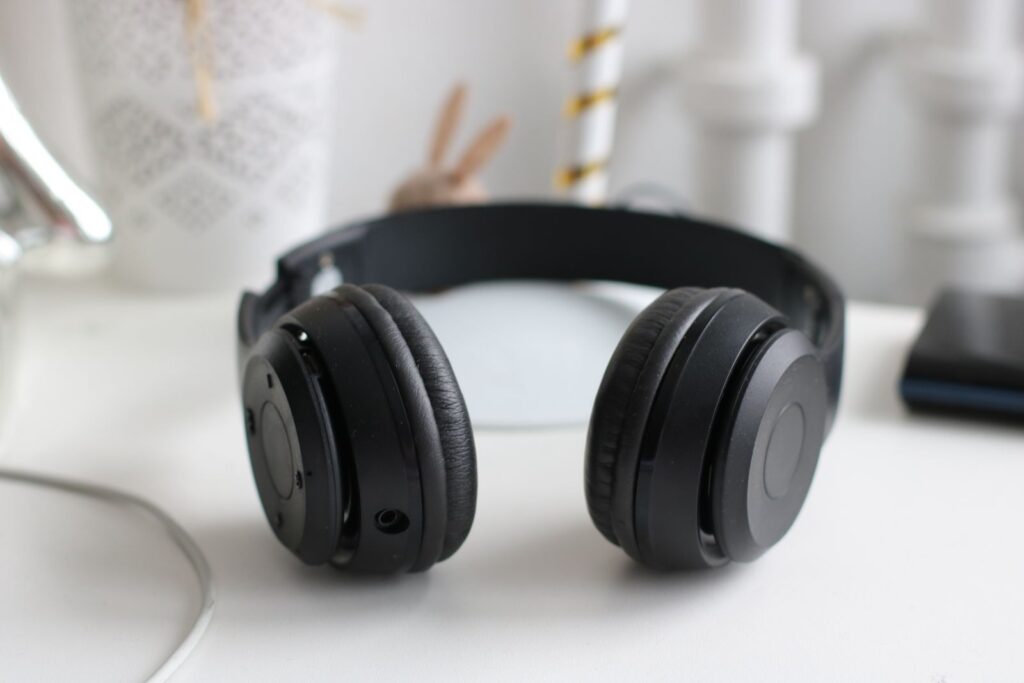
Short answer: Noise-canceling headphones use tiny microphones to listen to the sound around you, then play a mirror-image sound through the speakers. When the original pressure wave and its mirror image meet at your ear, they largely cancel each other. It works best on steady, low-pitched drones such as engines and air-conditioning, and much less well on sudden or high-pitched sounds such as voices.
Key takeaways
- Sound is a pressure wave, and two waves of equal size that are exactly opposite in timing add up to nothing.
- Active noise cancellation (ANC) is electronics making “anti-noise”. Passive isolation is just a physical barrier, like an earmuff or a snug ear tip.
- ANC is strongest on steady low-pitched sound. Passive isolation does most of the work on high-pitched sound.
- Hybrid designs use one microphone outside the ear cup and one inside, because each position fixes a weakness of the other.
- Cancelling the noise does not make loud music safe. Volume still matters for your hearing.
Sound is a pressure wave
Start with what you are trying to cancel. Sound is created by a vibrating object, and it travels through a medium such as air as a longitudinal wave. That is a wave made of regions of high pressure, where air particles are squeezed together, and regions of low pressure, where they spread out. The particles themselves only shuffle back and forth around their resting positions. It is the pattern of squeeze and release that travels, much like a ripple of brake lights moving down a motorway while each car only moves a short distance.
Your eardrum responds to that pattern. Pitch is how fast the pattern repeats: a slow repeat is a low rumble, a fast one is a whistle. This matters later, because the speed of the pattern decides how hard it is to cancel.
Anti-noise: how two waves can make silence
When two waves meet, they simply add together. This is called interference. If the peaks of one line up with the peaks of the other, the result is a wave with twice the amplitude (the size of the swing). If the waves are half a cycle apart, 180 degrees out of phase, a peak of one lands on a trough of the other. For waves of equal size, the result is zero: they cancel completely.
A noise-canceling headset exploits exactly that. The steps, in order:
- A microphone picks up the unwanted sound.
- A small processor flips the signal, so every squeeze becomes a release and the reverse.
- The speaker in the ear cup plays that flipped signal, the “anti-noise”.
- At the ear, the noise and the anti-noise meet and partly cancel, so less sound reaches the eardrum.
Notice what does not happen. The noise is not erased from the room, and nothing is “absorbed”. Cancellation is local, in the small pocket of air between the speaker and your eardrum. A science-blog summary notes the same limit: cancelling across a whole space can quiet some spots while doubling the noise in others.
The race against the clock
Real cancellation is a timing problem. The anti-noise has to arrive at almost exactly the moment, and with almost exactly the shape, of the noise it is fighting. An engineering article on headset design gives a sense of the scale: with a microphone about 0.7 centimetres from the speaker, sound takes roughly 20 microseconds to cross that gap. A digital system has to convert the signal, process it and convert it back within about that window, which is a fraction of a thousandth of a second.
The same article explains the consequence. Digital processing leans heavily on prediction, which suits steady-state noise such as a constant engine drone. A steady hum is predictable: what it did a moment ago is a good guide to what it will do next. A door slam, a cough or a clinking spoon is not, and it may be over before any anti-noise can be built.
Why low and steady wins
Two things work against high-pitched sound. First, it changes quickly and unpredictably, so the timing target keeps moving. The engineering article notes that above a few kilohertz the wavelengths get short and the cancellation timing becomes critical. Second, the ear cup itself does a decent job on high pitches without any electronics, so ANC is aimed at the gap that the cup leaves.
That is why a headphone maker’s own help page says its noise canceling is effective in low-frequency settings such as aeroplanes, trains, offices and near air-conditioning, and less effective for higher-frequency sounds such as human voices. Read that as a design statement, not a flaw: the technology was built for droning noise.
| Type of sound | Example | How well ANC copes |
|---|---|---|
| Steady, low-pitched | Aeroplane cabin, train, air-conditioning hum | Good: predictable, so the anti-noise can be matched |
| Speech, mid and high pitched | Colleagues talking, a baby crying | Reduced: changes quickly, ear seal does more of the work |
| Sudden or sharp | Door slam, dropped cutlery | Poor: may end before the anti-noise arrives |
Active cancellation versus passive isolation
Passive isolation is what happens when you put a barrier over or in your ear. It needs no battery. According to the engineering article, passive isolation becomes effective from about 500 hertz upward and is commonly 20 to 30 decibels above a few kilohertz, while good earphones manage roughly 5 to 30 decibels at low frequencies. Active cancellation, by contrast, works from about 20 hertz up to a few kilohertz, which is exactly where a physical barrier is weakest.
So the two are partners, not rivals. A badly fitting ear cup leaks sound and weakens both. One manufacturer help page even suggests checking that the headset sits comfortably and that the feature is switched on when the effect seems weak, which is a modest but honest first test.
Feed-forward, feedback and hybrid, in plain words
Where the microphone sits changes how the system behaves.
Feed-forward: the microphone outside
A microphone on the outside of the ear cup hears the noise before it gets to you, then the system works out what anti-noise to send. The engineering article says this design can reach a “sweet spot” of more than 25 decibels of cancellation, with a bandwidth up to about 4 to 5 kilohertz. The catch is that it cannot hear what actually arrives at your ear, so differences in head shape and fit change the result.
Feedback: the microphone inside
Here the microphone sits very close to the speaker and measures what you actually hear, then corrects the difference. This copes better with differences in fit, and the response is more even. However, the same article puts its bandwidth at around 1 kilohertz with up to about 20 decibels of cancellation, because delay in the loop and the risk of the system whistling (positive feedback) limit it. It can also colour the music, so makers often add equalisation.
Hybrid: both
A hybrid uses both microphones to offset each other’s drawbacks, at the price of more design complexity and cost. Think of a driver who watches the road ahead and also checks the speedometer.
| Design | Microphone position | Strength | Weakness |
|---|---|---|---|
| Feed-forward | Outside the ear cup | Wider range, up to about 4 to 5 kHz | Fit differences change the result |
| Feedback | Inside, next to the speaker | Hears what you hear, even response | Narrower range, about 1 kHz, can colour music |
| Hybrid | Both | Covers each other’s gaps | More complex and costly |
Hearing safety: quiet is not the same as safe
A common myth is that cancelling the noise protects your ears. It only changes how loud the surroundings sound. What damages hearing is the sound that actually reaches the inner ear, including the music you play.
The US National Institute on Deafness and Other Communication Disorders (NIDCD) explains that sound passes through the ear canal and middle ear into the fluid-filled cochlea, where hair cells bend and trigger signals to the brain. Most noise-induced hearing loss comes from damage to those hair cells, and human hair cells do not regrow. The institute says sounds at or below 70 A-weighted decibels are unlikely to cause hearing loss, while long or repeated exposure at or above 85 can, and the louder the sound, the less time it takes. It lists headphones at maximum volume among sounds of 94 to 110 decibels.
The CDC’s occupational safety institute, NIOSH, treats noise above 85 A-weighted decibels as hazardous, and recommends an exposure limit of 85 over an eight-hour workday. Decibels are logarithmic: a sound 10 decibels louder carries ten times the intensity. NIOSH also offers a rough field test: if you must raise your voice to be heard at arm’s length, the noise is likely hazardous. The World Health Organization says over a billion young adults are at risk of permanent, avoidable hearing loss from unsafe listening practices.
The sensible reading, as general science rather than medical advice: a quieter room means less reason to turn the volume up. But the volume control, not the ANC switch, governs your risk.
A buyer’s checklist: what the marketing does and does not mean
Marketing numbers rarely come with the fine print attached. Use this list before paying.
- “Up to X dB of noise reduction.” Ask: at which frequency, in which test? A single big number usually describes the best case, which is a low-pitched drone. Cancellation across the whole range is not uniform.
- “Blocks all noise” or “silence.” Not what the physics allows. Voices and sudden sounds come through to some degree.
- “Hybrid” or “adaptive.” Hybrid means microphones in two places. It tells you the architecture, not how well it is tuned.
- Fit. A poor seal weakens both passive isolation and ANC. Check the cushions or tips suit your head or ears.
- Safe volume. No headset makes loud listening safe. Keep the volume moderate.
Frequently asked questions
Do noise-canceling headphones really make sound disappear?
No. They reduce it at your eardrum by adding a mirror-image wave. The sound is still in the room, and the reduction depends on pitch, timing and fit.
Why can I still hear people talking?
Speech is higher pitched and changes quickly, so it is harder to predict and cancel. A headphone maker’s own guidance says noise canceling is less effective on higher-frequency sounds such as human voices. The ear cup blocks some of it passively.
Is noise cancellation bad for my ears?
The cancellation itself is just a sound wave added to another sound wave. The hearing risk comes from loud listening. NIDCD lists headphones at maximum volume among the sounds that can exceed the 85 decibel level where damage becomes possible.
Do I need ANC if I have well-sealed earphones?
A good seal already blocks much of the higher pitches. ANC adds the most where a seal is weakest, in the low rumble range, so the two work together.
The bottom line
Noise cancellation is clever, narrow and honest about its limits once you read the fine print. It adds a flipped copy of predictable low-pitched sound to cancel it at your ear, leaves speech and sudden bangs largely to the ear cup, and does nothing to make high volume safe. Judge a pair by fit, by the sounds you actually need to quiet, and by how loudly you listen, not by a headline number.
Sources
- Challenges Await In Noise-Cancelling Headset Design, Electronic Design
- 16.6: Interference of Waves, Physics LibreTexts (OpenStax University Physics)
- What is sound?, Discovery of Sound in the Sea, University of Rhode Island
- Noise-Induced Hearing Loss, National Institute on Deafness and Other Communication Disorders (NIH)
- Understanding Noise Exposure Limits, CDC NIOSH
- Deafness and hearing loss, World Health Organization
- How do Active Noise Canceling Headphones Work?, Scientific American
- Noise canceling function help guide, Sony (a manufacturer’s statement about its own product)
Last updated: November 2026.
This article is general information for curious readers, not professional advice.